Sunday, December 28, 2008

Towns and Ties - 1


It's the holidays and what better time than to reflect on the past and look into what makes you You. Corny I know but I thought I would like to post something that isn't necessarily wrought from the art hammer. See, I'm not from the midwest or should I say that although I was born in Belleville, IL and reside in St. Louis, MO I have a strong connection with the American Southwest. Mi mamá y papá vivos en San Antonio Tejas and I spent a long portion of my formative years basking in it's culture. Tucson and Albuquerque were stopping points for this military brat as well. Mi hermanos were born in these towns respectively. Recently I have become reacquainted with an old friend from SA. He was listed as the Interstellar Mexican in an email that I almost trashed if it were not for the abnormal reading of my junk mail.
The Interstellar Mexican as he called himself is actually Dario Flores III. I always liked that name. It implies an historic figure or a personal and storied past that must be important enough to continue telling.

Who the fuck is Dario Flores? We started art school together in 1991 at San Antonio Community College. I had forsaken a career in the biological sciences and Dario had escaped the small town of Luling, Texas. Luling is proportionate to Mascoutah, IL. to give you a midwest reference. I remember Dario explaining that his father worked for the railroad and I assume that this was the family legacy. His father being a Dario meant that my Dario would most likely follow along ....or not. I recall my first class as young art students. We had taken advertising art for our first semester and were sharing  computers because computers were very new and I think we had 5 computer stations for 3 classes that had 10 to 15  students in each. You can imagine the bottle necking and cluster fucking that went on to get homework and class assignments done. While computers were new to the academic art scene, trading, bartering, pestering and bullying  were not. Dario was this loud dude that was always pushing his way into the lab and offering slots of time to people who were already at a station. Once his time was up at one computer he would go to another and pester, barter, bully  or steal for another round with ancient Apples. For one reason or another he never bothered me. It could have been that we had separate classes so he hadn't found an angle to pry. While in lab I would always bend an ear when Dario was hustling for another slot. It amused me so much that I thought to ask this guy about his reasons for creating a spectacle. I don't really remember what he said; something like, "she's hot and he's the smartest one in the class man...". Never the less his answer was pragmatic and lent a utilitarian aspect to an otherwise disorderly approach.

A semester later we started a band called Rain In The Face. Dario thought of the name, was the chief song writer and vocalist while I handled the melody and guitar. Our first gig was in my history class taught by a man of Cherokee descent who had a busy schedule with the United States Supreme Court petitioning for the right of Native Americans to freely engage in ceremony and religion with respect to altered-states and indigenous methods of achieving them. Rain In The Face happened for many years after, most notably playing in the King William district at a book house that held a weekly open mic poetry reading. Later I will post some of our boom box recordings done over the span of those many years.

As our friendship grew so did our art in divergent strains. San Antonio College was a fertile place for young artists, actually the entire city was and still is. We had the Blue Star, Pace, Southwest Craft Center, Fine Silver, Cactus Bra and San Antonio Art Museum just to start . Then there's the many independent run spaces and alternative venues. When you got tired of that you could head up I-35 to Austin and  I-10 or I-90 to Houston - a day trip for either. Dario's work took off after entering into the fine art department and taking a class from Mel Casas. Mel was part of the Chicano movement in America. One can hear an opus to this period by listening to Ry Cooder's - Chávez Ravine. A second cousin to me - Eddie de la Vara, was a contemporary of the period along with Mel but you'll have to drive to Agua Prieta to see the 4' x 6' charcoal of a chicano Last Supper. Dario had started making large scale paintings referencing and riffing off Casas. I'd like to think that Brownies of the Southwest was a launching point for Dario. You can see a small image of this piece on Cheech Marin's Chicano website if you scroll through the paintings.

Dario and I went different directions after I got accepted to Washington University. I haven't seen or spoken to him in a while and it's good to hear from an old friend during the holidays. So what is he doing these days? Well, music and art are still happening but he's not so much the younger bully he used to be. You can follow the band he currently occupies here.

Saturday, December 20, 2008

sketch for nora


I gotta get this out of my chest with a sketch. The above drawing is a composite citing a Sigmar Polke appropriation of a medieval German print and a drawing of the guitar sculpture made by Picasso.

The sketch I want to emphasize is done in audio with guitar, two microphones, a vintage tube amp and distortion pedal.
I just bought a Shure Beta58A and SM57 off Craig'sList and was itching to try em' out. The amp is a 64' univox hooked up to a Boss OS-2 distortion pedal.
I bought the amp at an estate sale for $9 bucks and had it rewired and tubed by an electrical engineer pedal steel
player Scott Swartz. It's all class A with a beautiful built in tremelo!
I traded a crybaby wah for the pedal in 95'..best trade I ever made except for the Rudy Mays and Pete Rose baseball cards I got
for the Bucky Dent and Billy Martin cards. I don't care too much for baseball but as a kid I had a group of friends who
collected cards and caught snakes. I wanted to be on the better team so I tried to be a good collector. The distortion
pedal came from Mike Kiernan. I used to play with him in a two man
band called the Pussy Licks. We played the Venice Cafe, Ciscero's Basement and Gladstones but mostly we drank beer
and rocked my graduate printmaking studio at Wash U. till the wee morning hours. The band involved two guitars battling for attention. I have some tapes somewhere but that'll have to wait. Mike went on to play with Couch Bucket, an outfit comprised of Larry Bulowski and Sherman S. Sherman. Larry, Sherm and Maggie St. Germain then formed the Good Griefs which morphed into Sherm's Peck of Dirt after an unfortunate Good Griefs breakup (unfortunate to those of us in the audience who always saw a good show with Maggie on drums, Larry on guitar and Sherm on bass). Now moving on from St. Louis music mythology because I could branch out like a Kevin Bacon wet dream...and that ain't very appealing. What I came here to say: the sketch draws from Greek mythology. I encourage you to find the tale of Athena that pertains to her failed rape and the bastard child that comes of it. I'd like to do a video of the scene where Hermes and the other caretakers find the child intertwined with snakes. I've drawn a comparison of an abnormal megaly to the finding of the child. A personal discouragement and something I hate. Here's the sketch

Sunday, December 14, 2008

Ahhh..hate


Suite of photo's for a exhibition at Good Citizen. These images are
meant to be documentary stills. One image comes from passing the camera around to other members in the group.
The images are from the day we made Car Bomb.

Saturday, December 13, 2008

Poetry score for Nailed Seriphim

I participate in Poetry Scores, a non-profit which scores long poems in all creative media. I'm also a board member and unapologetically offer my creativity to the projects we produce. This particular sculpture was made in response to K. Curtis Lyle's poem Nailed Seriphim. The art must be titled from a line, word or phrase in the poem. The exhibition is hung according to where the line exists in the poem. This makes for an interesting curatorial take on the show. The poem determines where the work is hung. I suggest dropping in on the blog for Poetry Scores from time to time. There's lots of updates made by our creative director Chris King.

The audio for this piece comes from Gil Scott Heron's album "Pieces Of A Man", 1971. Track #4 - "Home Is Where The Hatred Is".
Tom Boyle helps on lead guitar as we do a cover version of the original. K. Curtis Lyle quotes the song title in his poem and
this gives me an opportunity to do an audio/visual score. When one asks the question "Who the fuck is Mortice Juwan Menifee?",
the scrutiny of a persons' past ensues and maybe, for most of us, there are things we'd be better off not revisiting. Privacy becomes public knowledge hence the television. Static informs the viewer that the revolution - seeking justice or the truth; will not be televised. Like the song says in the bridge before the second verse, "...and It might not be such a bad idea if I never, never went home again."

Saturday, September 06, 2008

windmillprisonspider


Sculpture made for Art In The Park, Jefferson City, Missouri.
The use of the ready made is becoming a theme in my current work.
Car bomb utilized a real car and this one investigates the
structure and vernacular of place.

New media also comes into play. For this piece I installed a video
projector and dvd player to project a spider making a web.
The projection is shot onto the ground and can only be seen at night.

There is a juxtaposition of similarities when you look at the structure
and movement of the windmill and spider constructing it's web.
There's even similarity between images and objects that corresponds
to a rural setting. I was interested in place as context and added
the word "prison' to drive the theme. I was also tempted to finally
title a work based on the work of Guided By Voices. It wasn't a literal
homage but something in likeness.

Music, I hope, finds a place in all my work. Thanks to Christian Marclay, John Cage, Dan Graham, Thurston Moore, Lauri Anderson, Terry Allen...etc.
Terry told me in a phone conversation that there is no difference in the making of music and art. With the obvious differences of material aside, it's about ideas. Different idea delivery systems.

Saturday, March 29, 2008

HATE/video

Song: Written by myself and Greg Edmondson.
I recorded a conversation that took place between him and I
over some cocktails. The lyrics are pretty much verbatim. 
Music: Robert Goetz
Players: Sherman S. Sherman - bass
               Merv Shrock - piano, background vocal, engineer
               Robert Goetz - guitars and vocals
Recorded and mixed: In Merv's basement on a two track tape recorder.
Mastered in hifi at Sherms

Video: Footage taken by Robert Goetz and Sherman S. Sherman during  3-1-08 trip to Sherm's land to pick up "Car Bomb" sculpture.
Camera: Sony Handycam, Super SteadyShot DCR-TRV17 NTSC
Edited by: Robert Goetz using Final Cut Pro 6

Please note: Neither Sherm or myself are affiliated with SatanHates.com.


Wednesday, March 05, 2008

Wednesday, February 27, 2008

Flip Flop Fly (Big Joe Turner)

click on title to listen

Yeah....Kansas City Blues. We cooked it. Kasten on the board with the Acoustic Death Ensemble.
I don't care....naw mean? 

Monday, February 18, 2008

Loss

click on title to listen.

Acoustic Death Music project:
Goetz - guitar, vocals
Woodson - bass
Tkach - drum
Kasten - engineer


A Bad Song I Am

click on title to listen.

Acoustic Death Music project:
Goetz - guitar, vocals
Woodson - guitar
Tkach - drum
Sherm - bass
Kasten - engineer

Song is an adaptation from an original Modoc Indian song given to me by Chris King. I gave it a chorus and some chords.

another version of car bomb

click on title to listen

Thursday, January 31, 2008

paranoid

click on title to listen

7. Paranoid (demo) 2:40
Robert Goetz - guitar, vocals

larry harry's eyeball

click on title to listen

6. (That’s How They Won WWI) Larry Harry’s Eye Ball 2:14
Excerpt from video shot in Dec. 2007

car bomb

click on title to listen

5. Car Bomb (demo) 3:37
Robert Goetz - guitars, vocals

she's awesome with a pistol

click on title to listen

4. She’s Awesome With A Pistol 1:40
Excerpt from video shot in Dec. 2007

HATE

click on title to listen

3. Hate 3:11
Merv Shrock - engineer, backing vocals, piano
Robert Goetz - guitars, vocals
Sherman S. Sherman - bass
Words by Greg Edmondson and Robert Goetz

357

click on title to listen

2. 357 M***** F*****...Oh S***, What’s That?! :35
Excerpt from video shot in Dec. 2007

Tuesday, January 29, 2008

light it up...

click on title to listen

1. Light It Up Suckers 1:53
Excerpt from video shot in Dec. 2007

Monday, January 21, 2008

HATE


Hate Project: Car Bomb, 2007-2008

Special Thanks to Sherman S. Sherman

and these fine folks....

Ross and Kim
Larry Harry
Nick Lang
Brett Williams

Monday, February 20, 2006

Architectural Reprogramming

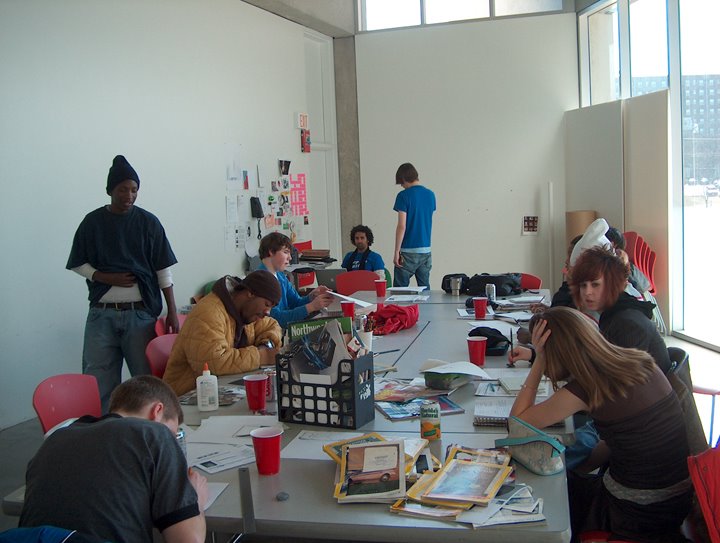
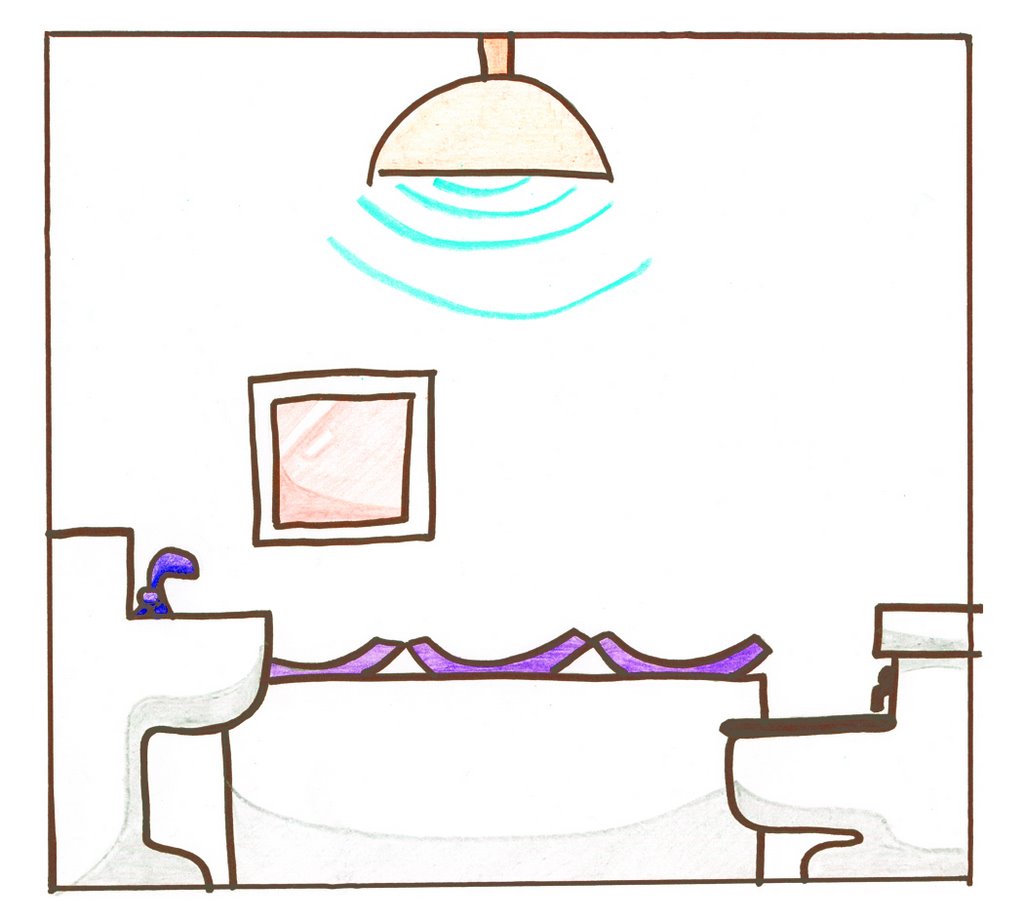
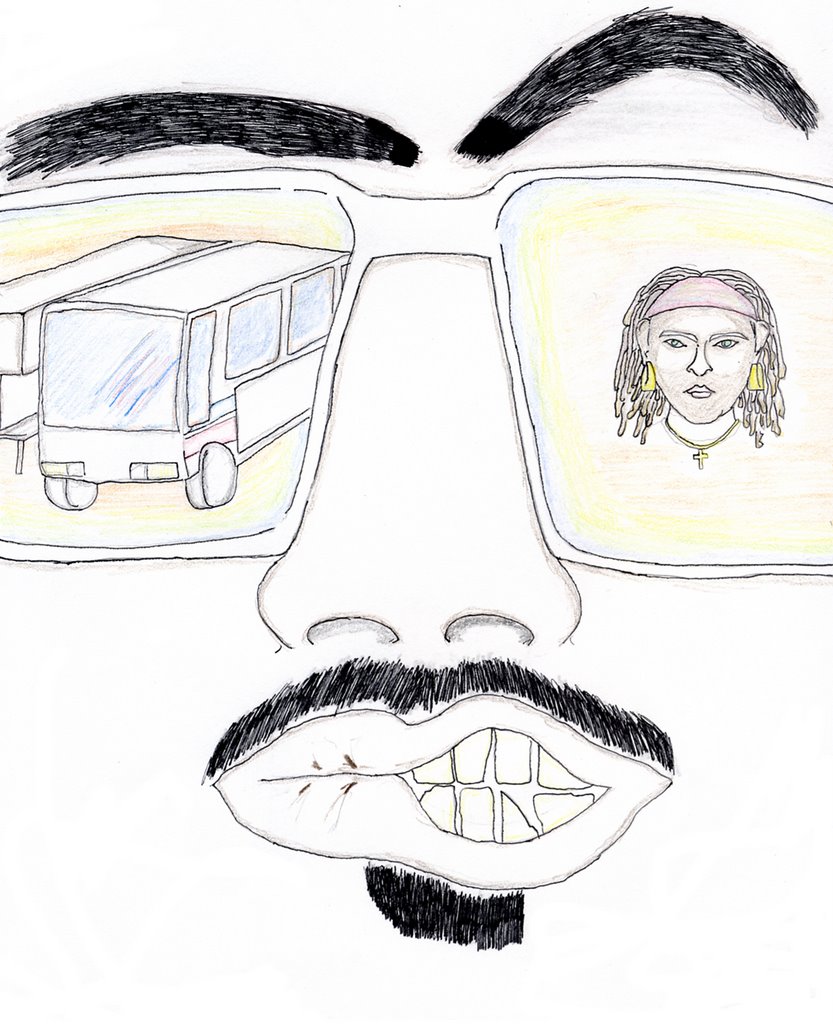
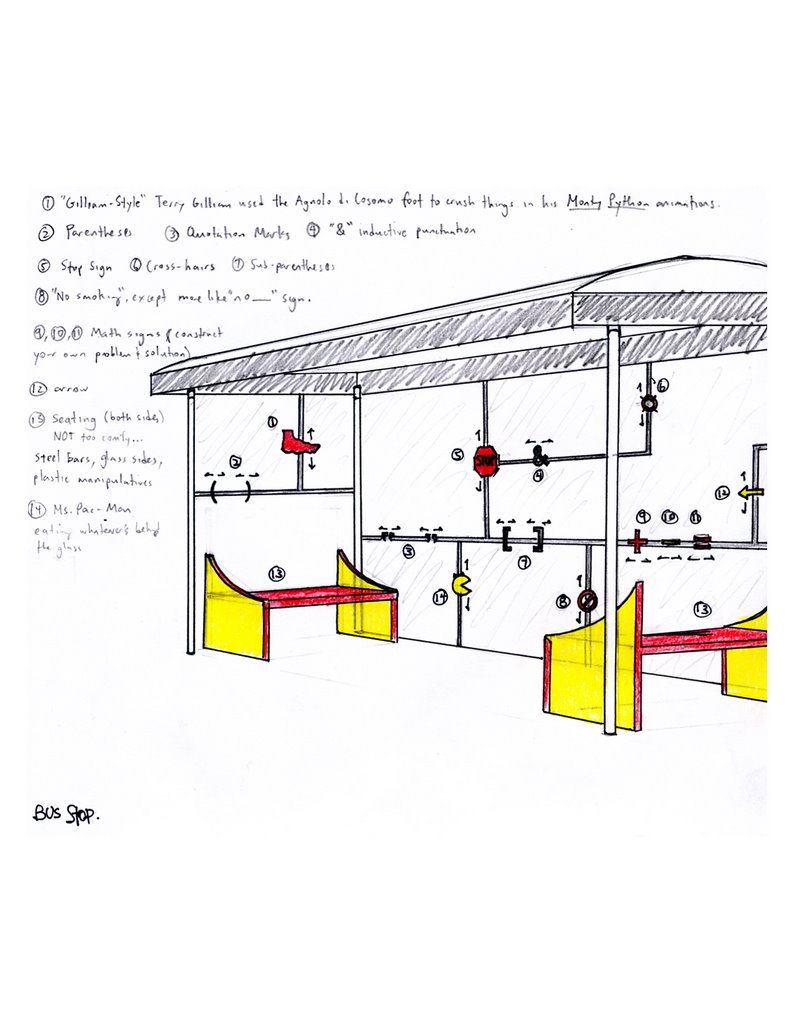
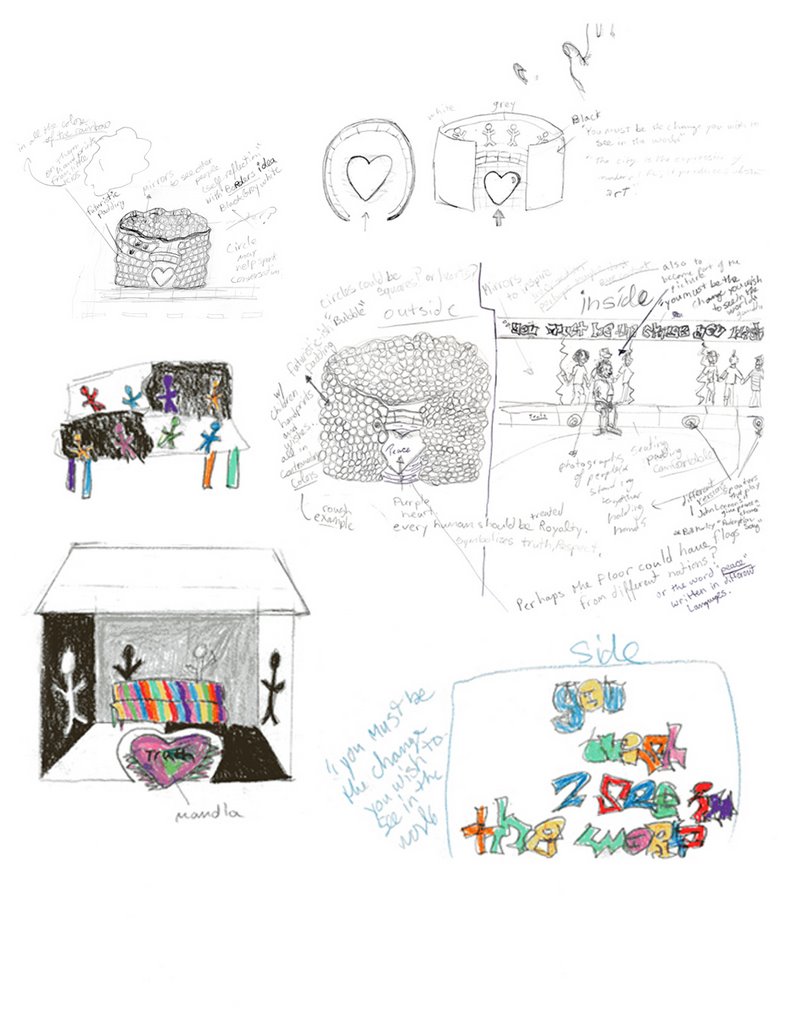
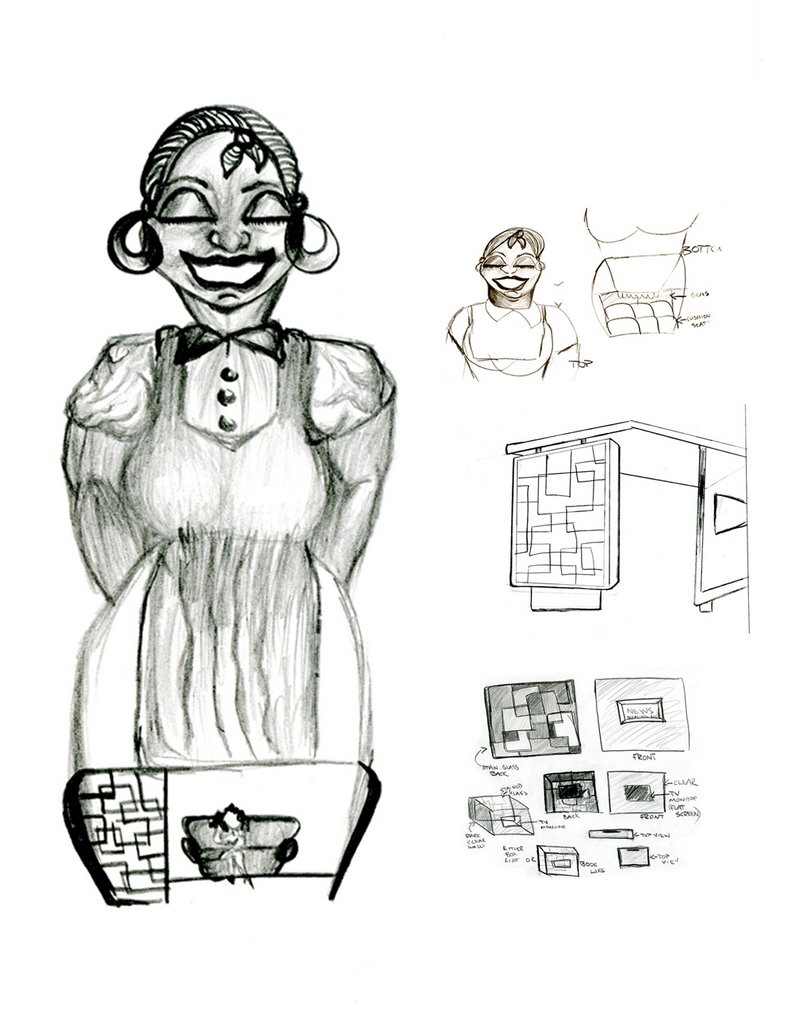
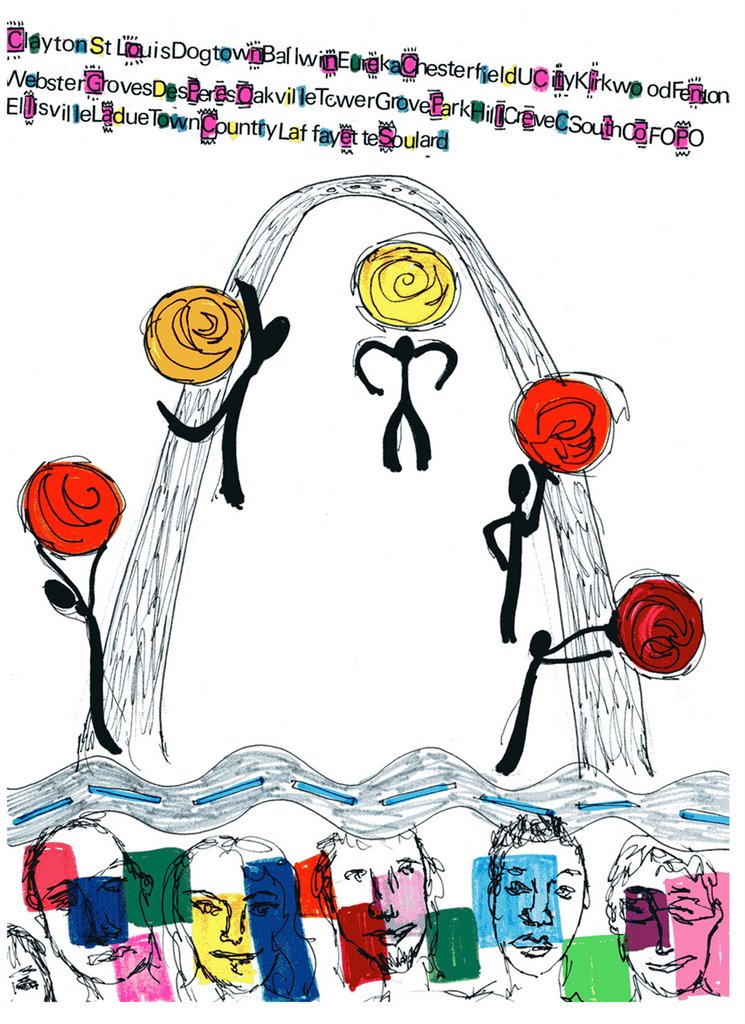
Below is a project that I submitted to New Art In The Neighborhood. NAN takes place on Saturday from noon to 4pm at The Contemporary Art Museum St. Louis. NAN is a class offering a muti disciplinary arts education to highschool aged students interested in developing skills, language and work which focuses on issues in contemporary art. This project allowed me to function as a mediator in overseeing the development of ideas and casting the group into the role of “Public Artist “. The outcome of this project is submitted to AIT for possible inclusion in the bus stop art project series. If images are selected to be installed the following stipend will go directly into a scholarship fund for students of New Art In The Neighborhood.

Project description: How do we extend the program of the space?

Program means different things depending on what context we place the term in. Here we are placing the term into public spaces and more precisely we will investigate program in the architectural social space known as the bus stop. Program in this case refers to the way we use the bus stop. The program determines how the space communicates the process we engage in. Architectural design can help give rise to a social code known as a program. We are programmed to conduct ourselves based on the design of the space. Program is site/place specific and we can see there is already certain social codes or ways to act in place for specific spaces. What happens when we change the program? What can we do to enhance, extend, restrict or recode the program of the bus stop?

Questions you can ask yourself to start the process:
How do I activate the space? What do I know about the space I'm trying to reprogram? Do I have a relationship or social code I already perform in this space? Are there other uses this space could serve? Is this the most boring project I've ever heard and why? Maybe it's the fact that bus stops are boring. We can start with the social code in place and make small adaptations like what AITis asking for or we can extend the idea by suggesting the rewriting of the program....some options might be:

- interactive components
- displays
- text
- color
- the way we interact with
others in the space
- sound/performance
- video/performance
- changes in architectural design/materials
- changes in the way we perceive the
inside/outside environment
- inclusion of site history and regionality


Sunday, January 29, 2006

Nosey Parker on the WEB

Brett and I have started a site to collect text, commentary and updates revolving around our Temporary Autonomous Zones project. It could be construed as a new library of sorts. Please feel free to visit and add to our collection.

Robert

Wednesday, January 11, 2006

POST MODERNISM IS DEAD!

Just a short introduction to a wonderful idea. I had asked my friend and fellow artist Greg Edmondson if it was cool to approach Minsoo Kang and Phil Robinson (curators of the Post-Ironic Lull) regarding the installation of some of my work. Greg shrugged his shoulders in an approving gesture and I was off to go nuts with very little time....I love trying to make work for a show that has a considerable roster of talent cuppled with an immence concept and not having a clue what to do 3 weeks before the opening...it's literally nutty time. Minsoo's essay below sparked the exhibit.


© Copyright 2005 Minsoo Kang (kangmi@umsl.edu)


THE DEATH OF THE POSTMODERN

AND

THE POST-IRONIC LULL

Minsoo Kang

The cultural moment that was identified as the postmodern is over.
A convincing case can be made that postmodernism was already at a moribund stage in the late 1980s and died a series of deaths in the first years of the following decade. If this is the case, the questions we are faced with are what has come in the wake of postmodernisms death?; what new ideas and conceptions of humanity and society have been introduced into the culture since the demise?; and, how are we to describe the cultural moment of our own time?
We are in a period of the post-ironic lull.

I felt compelled to meditate on contemporary culture while putting together the syllabus for an introductory course on Western intellectual history I am teaching at the University of Missouri in St. Louis. The class was designed to give my students a sweeping view of the most significant ideas and movements that shaped the Western mind from the time of the ancient Greeks, with a significant space at the end for the latest developments in the intellectual world. As I was considering reading materials for the last part of the course, however, I noticed that the works I was looking at, including Michel Foucaults History of Sexuality (1976; US publication 1978), Jean Baudrillards Simulacra and Simulations (1981; US pub.1983), Donna Haraways A Cyborg Manifesto (1985), and Judith Butlers Gender Trouble (1990), were all at least a decade and a half old. Moreover, I realized that in the last fifteen years there has not been a single work published that created the kind of impact on the general intellectual scene as did Jacques Derridas Of Grammatology (1967; US 1974), Thomas Kuhns The Structures of Scientific Revolutions (1970), Clifford Geertzs The Interpretation of Cultures (1973), Hayden Whites Metahistory (1973), Edward Saids Orientalism (1974), and Foucaults Discipline and Punish (1975; US 1977). When I consulted my colleagues in the history, English, and anthropology departments, they confirmed that with the exception of some original works in specific subfields (e.g. postcolonialism, identity politics, gender studies) and compelling but hardly revolutionary works by such contemporary thinkers as Slajov éiûek and Bernard-Henri LÈvy, the intellectual world has been in the doldrums for the last decade or so. This was reflected in the rather torpid mood of recent academic conferences, in contrast to the meetings of the 1980s and early 1990s when poststructuralists and their opponents (both classical positivists and traditional leftists) clashed in often spectacular duels of ideas.
In my own experience as well, when I first began graduate school in European history at the University of California, Los Angeles in 1988, I was informed early on that poststructuralism was already in decline in France (Foucault died in 1984) as the younger generation of French intellectuals were more interested in pursuing specific issues in the political arena rather than engaging in abstract criticism of systems of knowledge. Nevertheless, UCLA was one of the major institutions in the US where vigorous and sometimes bitter debates about critical theory and postmodernism continued into the 1990s. Then in 1994, I had to return to my native country of the Republic of Korea to fulfill my mandatory military service.
After a twenty-six-month stint in the army, at a base near the Demilitarized Zone, and taking some time after my discharge to come to terms with the experience by writing about it, I finally came back to UCLA in 2000 to finish my studies. Upon my return, I discovered that while many of the people involved in the debates of the early 1990s were still there, the issues were no longer so contentious. In what is a sure sign of an intellectual movements decline, many poststructuralist ideas and postmodern attitudes had been assimilated into the general academic discourse without altering its agenda in any fundamental way. So I often encountered scholars who would never describe themselves as a poststructuralist or even a theorist but who found some aspects of Lacans or Foucaults works useful enough to utilize them in a moderate fashion in their own writings.
As I finished my degree and began my career as a history professor, I began to think seriously about the intellectual lull in contemporary culture, an issue of special interest to me since my field is in intellectual history. At least since the sixteenth century in the West, the period in which the dominant intellectual movement was in decline was also the period in which the next leading movement was in ascendance, with a few decades of overlap when the two were in conflict. For instance, the founding works of the Scientific Revolution, Copernicuss On the Revolutions of the Heavenly Spheres (1543), Keplers The Secrets of the Universe (1596), and Galileos The Dialogue on the Two Chief World Systems (1632), made their initial impact in the intellectual world not in the wake of the old Aristotelian worldviews demise but while it was still very much in force, as evidenced by the churchs persecution of Galileo in the 1630s. It is only with Isaac Newtons Principia Mathematica (1687) that one can speak of the final triumph of the new paradigm.
There is always an element of the arbitrary in pointing to a moment as the end of a historical period or of a cultural movement, but the date that for me marks the death knell of postmodernism in the US is June 18, 1993, when the Arnold Schwarzenegger film The Last Action Hero premiered. A thoroughly postmodern work employing the standard devices of self-reference, ironic satire, and playing with multiple levels of reality, this action-movie-about-action-movies became, despite its enormous budget, state of the art special effects and a superstar and a director with proven track records of success, the most famous box office disaster for years. In fact, its status as a postmodern artifact is heightened by the very fact that its fame rests on its failure rather than its content (signifier rather than the signified). And in the US, theres no surer sign of an intellectual ideas final demise than its total appropriation by mass culture. The actress and comedienne Aisha Tyler subtitled her recently published book on her musings, Reckless Observations of a Postmodern Girl. This, despite the fact that already in 1989 David Foster Wallace, in his novella Westward the Course of Empire Takes its Way, presented the highly embarrassing situation of a woman who has the gall to actually call herself a postmodernist (No matter where you are, you Dont Do This. By convention its seen as pompous and dumb.).
So what are we make of this lull in the intellectual scene of the last decade and a half? Where is the new cultural paradigm that should have already been in ascendance in the late 1980s? Is it possible that the direst and the most hysterical warnings of traditional humanists-rationalists-positivists came true that postmodernism and poststructuralist ideas made such a thorough assault on all notions of objectivity, rationality and reality, exposing the hidden agendas and power structures behind every ideology, conceptual system, and linguistic structure, that they made it impossible for contemporary thinkers to posit any new system of knowledge? As the postmodern died, did it drag all of Western thought with it to the grave, leaving its minor caretakers only the task of mopping up the remnants of defunct orders?

A few weeks ago, I was discussing these questions with a colleague at the fine arts department who is also a professional artist, when I suddenly realized that the new paradigm and the cultural moment after postmodernism was not only right before my eyes but the very subject of our conversation. Martin Heidegger, in his 1929 essay What is Metaphysics, pointed out that science claims to study what is and what exists, and beyond that nothing, but then asks, What about this nothing? The nothing is rejected precisely by science, given up as a nullity. But when we give up the nothing in such a way dont we just concede it? In a similar way, I thought, After the demise of postmodernism, there is this lull in the intellectual scene. But what about this lull? Is this lull a pure negative state of affairs where nothing is happening? Or is the lull precisely the thing what is happening in the contemporary period?
This led me to postulate that we are in a cultural moment that could be called the post-ironic lull, and that this was the new paradigm that was in ascendance in the late 1980s and came truly to the fore in the second half of the 1990s. Scholars in forward-looking fields have been mulling over the lull and waiting for its end with the arrival of a new system or methodology of knowledge, not realizing that this mulling and waiting are what defines our age, our intellectual scene. So far, it has been an unproductive mulling and waiting since those activities or inactivities have not been recognized as the very modes of discourse in the post-ironic lull. Now that the moment has been identified and named, however, some strategies can be worked out to produce lullist thought and art.
The lull is post-ironic not in the sense that it rejects irony (one of the more obtuse questions that was asked in the wake 9/11 was whether the event marked the end of irony), but that it comes after postmodernism whose primary mode of discourse was irony. The lull employs irony, but with the full awareness that it was something handed down to it and so carries a whiff of the uncanny, like the clothes of an older sibling who met an untimely death. The lull also inherited the postmoderns critical and experimental spirit as well as its ingrained skepticism toward any totalizing ideology (contemporary thinkers, including éiûek and LÈvy, tend to avoid having their ideas solidify into rigid systems by opting to write in a concise, meditative format or by repeatedly changing positions on key issues). What differentiates them is that while the postmodernist attitude is predominantly ironic, critical, and experimental, the lullist attitude is suspenseful, tentative, and anticipatory - or, to be more accurate, ironic, critical and experimental in the larger context of the suspenseful, tentative, and anticipatory mood of the lull. Anxiety of influence notwithstanding, the post-ironic lull both continues and dissociates itself from the postmodern, in the same way that postructuralism came out of and rejected structuralism.
A key aspect of the post-ironic lull is that while the lullist is waiting for the lull to end, for the next system of knowledge or cultural movement to take us out of this liminal or interstitial period (there is a group of artists and writers who are associated with an Interstitial Art Foundation), she secretly dreads that very end, for the fear of what may come after, what may already be slouching toward Bethlehem. When the lull is over, we might be faced with some monstrosity of totalizing surety, perhaps a new-fangled version of retrograde nationalism or religious fundamentalism. So even as a lullist waits and tries to come to terms with the discomfort and uncertainty of waiting, she tries constantly to delay the lulls end. For those on the traditional left, this may mark the post-ironic lull as an essentially conservative moment, in the same way as contemporary Marxists scholars such as Frederic Jameson and Perry Anderson have characterized the postmodern as a late capitalist reaction, since it seeks to postpone revolution indefinitely. For the lullist, however, delaying is a defensive act against the myriad dehumanizing systems that have often been created by triumphant revolutionaries and reactionaries alike. This attitude is the result of the cultural response to the historical events of the last decades which saw the end of the Cold War usher in a period not of increased peace, prosperity, and liberty for the world as a whole, but of the global expansion of corporate imperialism and renewed ethnic and religious fanaticism.
In the lullist version of Waiting for Godot, Vladimir and Estragon are not so naÔve as to think that the arrival of Godot will end their loneliness and uncertainty. They know that Godot did come numerous times in the past, and in many of those occasions he created situations infinitely worse than the one they are in now, including those of war and of totalitarianism. So they learn to appreciate the period of waiting, make the best of it, revel in it, and finally pray that Godot will never come.
The productive as well as liberating aspects of the post-ironic lull begin with this recognition of the lull as a possible space of boundless creativity and experimentation, following the demise of a cultural movement that was replaced by the Heideggerian nothing. One can then begin to write the lullist history, the lullist political theory, the lullist philosophy, the lullist psychology, compose the lullist music, the lullist novel, the lullist play, the lullist poem and create the lullist painting, the lullist sculpture, the lullist architecture, the lullist film. Such works would see the contemporary moment as an in-between state, filled with anticipation and hope as well as suspense and dread, and celebrate the temporary suspension of rules in the moment by creating multiple sets of rules that sometime contradict one another.
One such rule would be that the language of lullism should be as comprehensible as possible, though with intimation of multiple layers of meanings. This would be in direct reaction to the obscure and overly technical language of postmodernism a necessary act for that movement since poststructuralist thinkers had to create an entire language for themselves in order to critically examine the nature of language itself. The post-ironic lull, however, would express itself as much as possible in everyday language, but under the condition that its statements should be open to many different readings and many dimensions of significance. For instance, in lieu of a work by Derrida, the lullist may utter the old Zen koan: When someone points at the moon, only a fool looks at the finger. This could suggest different attitudes toward and interpretation of deconstruction (e.g. is the fool truly a fool, or a kind of wise fool who sees something nobody noticed before?). The ultimate point would be the indefinite suspension of definitive meaning, or the moment definite meaning is finally imposed.

I imagine an allegory of the post-ironic lull from an early episode of the Trojan War. Ships from all over Greece gather at the port city of Aulis to launch the invasion of Troy. Unfortunately, their leader Agamemnon offends the goddess Artemis in some way and she causes the winds to die down, immobilizing the fleet. Agamemnon finds out that to make amends, he must sacrifice his favorite daughter Iphigenia. After some hesitation, he summons her to Aulis, under the false pretext of a marriage to the hero Achilles.
During that period of waiting, a frustrating lull for these brutal warriors, Diomedes, the prince of Argos, is met by Thersites who is identified by some as his cousin. In The Iliad Homer describes the latter as the ugliest man in the entire Greek army, who is beaten by Odysseus for suggesting that they forget about the stupid war and go home, while another source tells the story of how he was murdered by Achilles for ridiculing him on the battlefield. Despite his connection to Diomedes, some scholars consider this contentious figure to be a portrayal of a low-class foot soldier, the only such character in the Homeric epics.
After listening to the noble Diomedes complain about the lull and his impatience to set sail and make war on the Trojans, Thersites characteristically contradicts him.
Foolish son of Tydeus, you are bursting with frustration because you cannot wait to embark on this wholly idiotic war and claim your glory and booty in the foreign land. Dont you know that this moment, this lull we are in now, is the best time you can possibly hope for in this entire enterprise? If you had any sense, you would realize that what you will face in Troy cannot possibly live up to the fantasies of excitement and victory in your savage mind. From the moment you land on those shores, the reality of war, death, and barbaric cruelty will set in and shatter your naÔve expectations.
But here, as we wait for our chief thug to murder his innocent daughter so we can get on our way here you can tell yourself all kinds of fanciful stories of glories to come and destinies to be fulfilled. You think this lull to be a curse of the gods, I say it is a gift. An all too precious one that will taken away soon enough with the scream of a young girl destroyed.
I myself wish that this lull would never end, so I can dream away without hurting anyone. This is the best time of this story, and it will all be downhill from the moment the winds move again. Your eyes are firmly fixed on a ridiculous and impossible future, Prince of Argos, while mine are set on the present. This present so exquisite in its stillness, its suspense, its freedom.
It is at this time and on this place of Aulis that I will sing my song, dance my dance, and offer my prayer to the god of delay, if such a deity should exist. The past is a graveyard and the future a dark cave, so I will dally in the garden in between as long as possible and love the lull as I love life itself.

Sunday, January 08, 2006

Early Model for TAZ


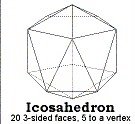
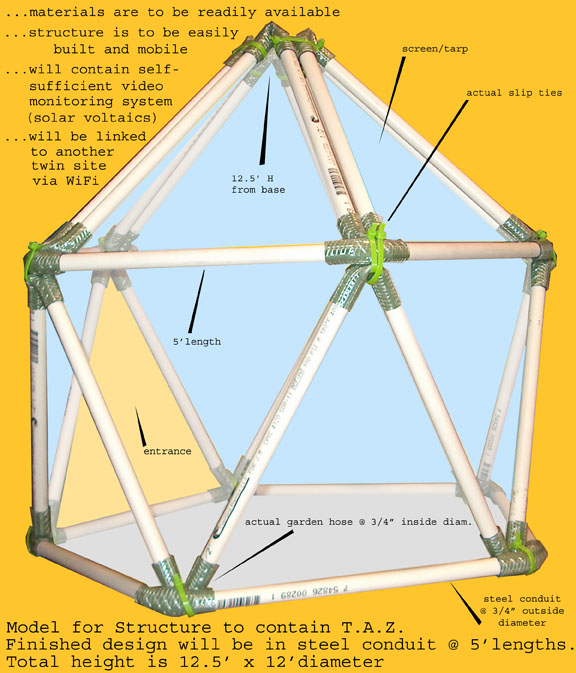
The first image is a rendering that could reference an abstraction or generalization of the structure of a virus. I started with this idea because it called to mind a collaboration I had with my brother Dr. David Goetz, a research scientist in molecular biology at the University of California, San Francisco. His research at the time focused on the structure and magnetic charges of proteins occurring in the SARS virus. Here was something I thought was very exciting and very true in fields of study where structure is a primary concern. As a sculptor I had also come to realize that function follows form. The "function" in terms of art is wide open. First you have to determine what you are trying to accomplish; whether it be pragmatic or not. Generally: art, by it's own nature, slides between and shape shifts into other disciplines. In doing so the artist uses a pallette of ever increasing proportions.
The second image is a truncated icosahedron. It became a three dimensional study model for the construction of the TAZ. Here we see an experimentation in materials with text refering to the conceptual and actual nature of the materials and structure.

Nosey Parker's TAZ @ ERGA TOPICA 2- Opening night

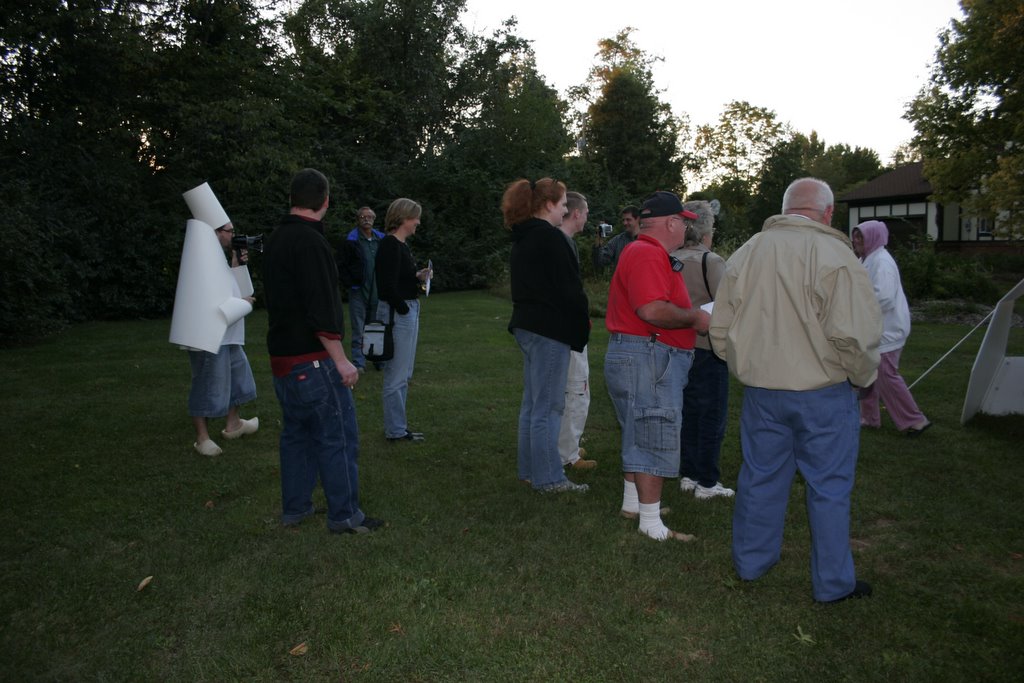
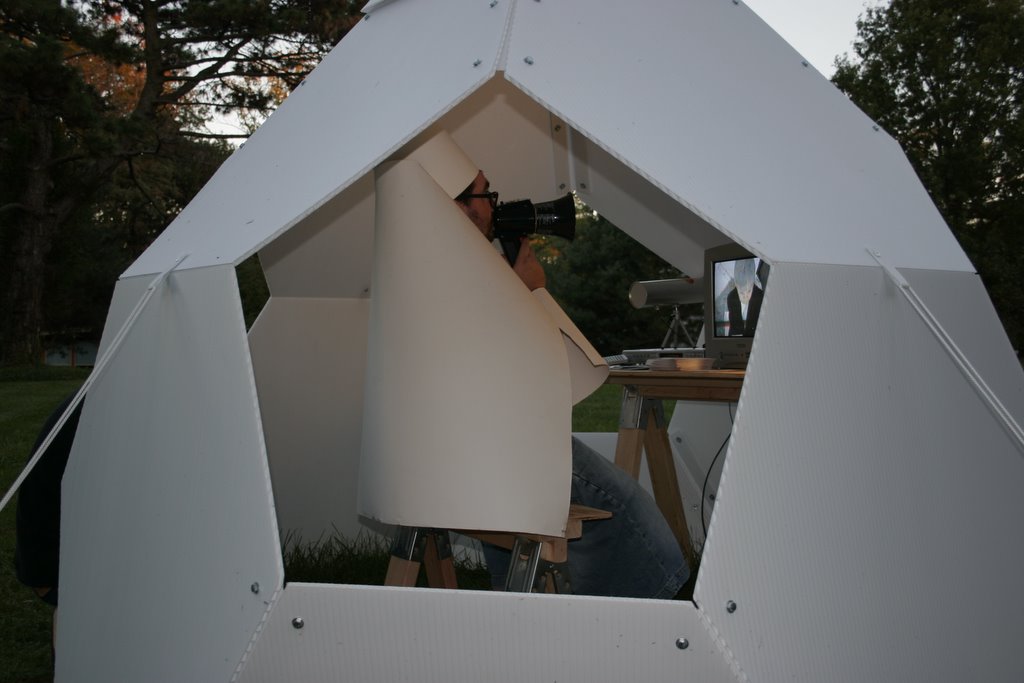
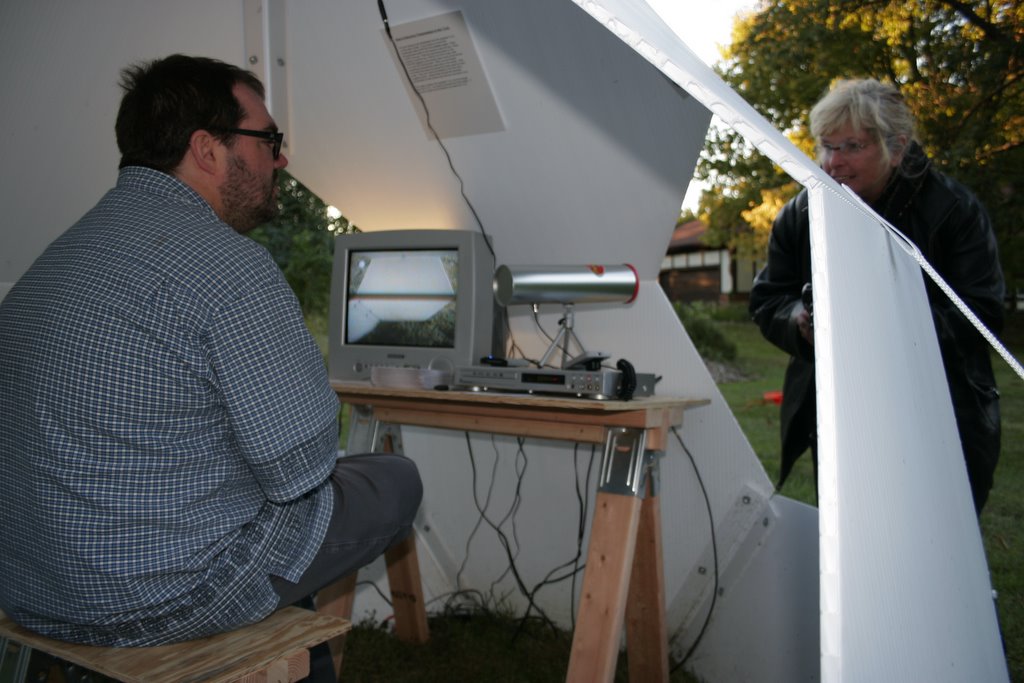
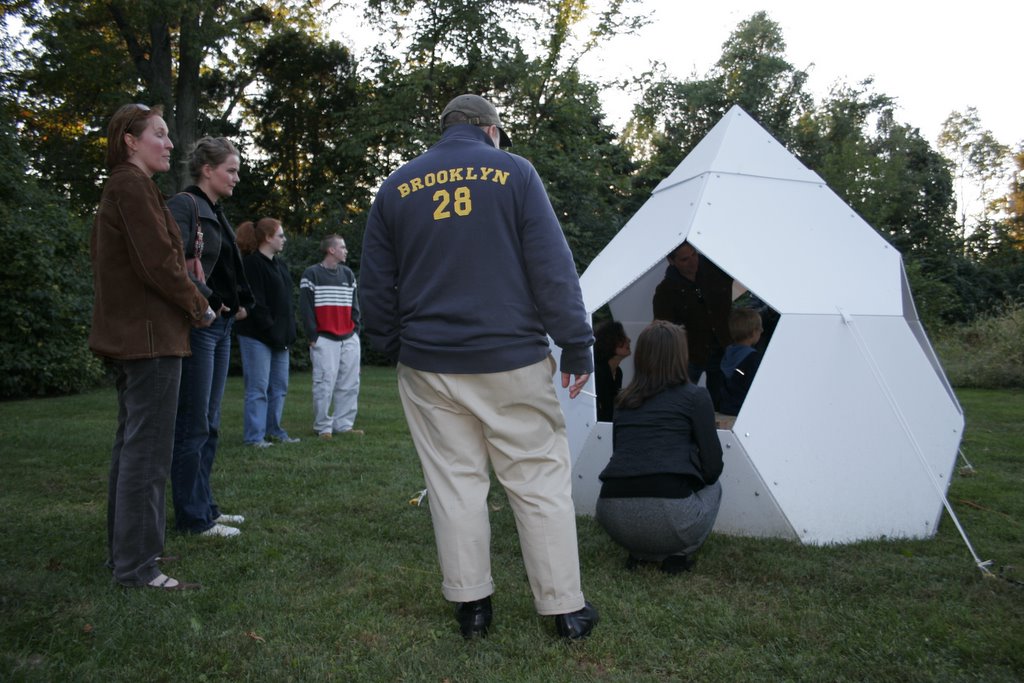
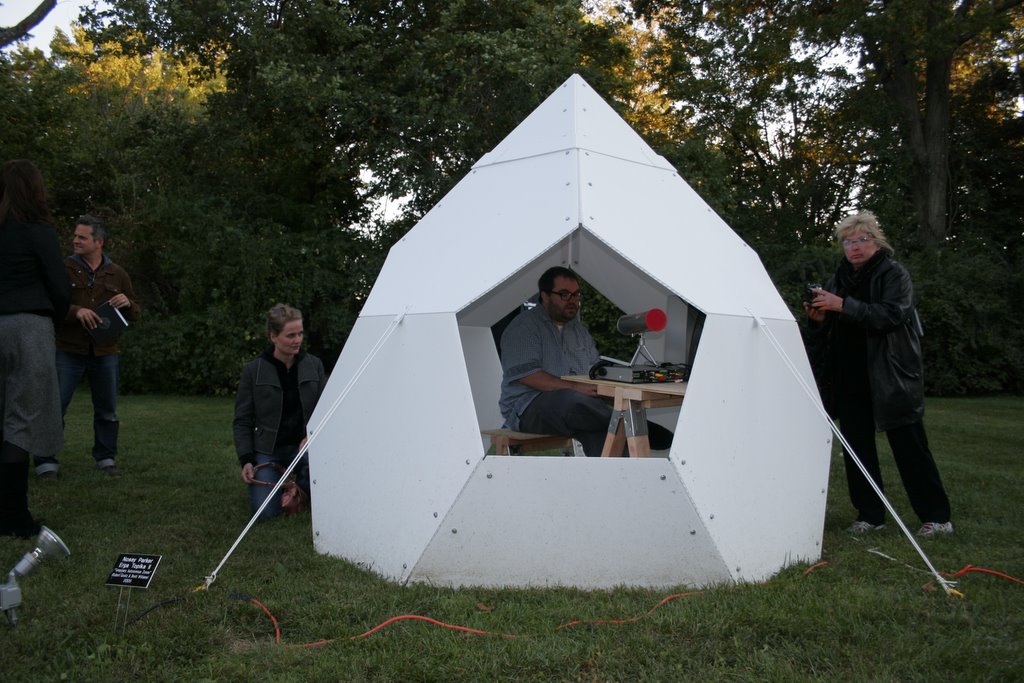
Erga Topica is an outdoor invitational curated by local sculptor, painter and educator Greg Edmondson. Erga Topica 2 featured Nosey Parker (Robert Goetz -Exhibitions Preparator, Laumeier Sculpture Park, St. Louis, MO and Brett Williams - Interactive media installation specialist, Science Center, St. Louis, MO); Craig Pleasants - Program Director, Virginia Center for the Creative Arts; Jennifer Odem - Assistant Professor in sculpture, University of Tennessee, Knoxville, TN; Alison Ouellette-Kirby -Associate Professor in sculpture, St. Charles Community College, St. Peters, MO; and Eric Troffkin - Program Director, School of Art, Washington University, St. Louis, MO. Erga Topica is a Greek term that roughly translates into English as site specific. Thomas Jefferson School of St. Louis, an independent boarding and day school, is the site in which this exhibition takes place. Nosey Parker's work consisted of two Temporary Autonomous Zones (TAZ's for short) designed and built by myself and outfitted with wifi video and DVD recording gear supplied by Brett Williams. The TAZ's were placed 320 feet from each other to approximate the width of the Mississippi river at the Mary Meechum historical site. All photo's taken during the exhibition were by Jamie Kreher, a local artist and educator.

Catalog Text:

Dear Viewer,

Maybe we’ve turned aside the normal role of the artist and have asked the viewer to shift from the passive spectator and made him or her the subject. We cant speak for everyone but everyone can speak and thus there’s an unexpected and actual exchange between artist and viewer. It’s definitely like Nosey Parker is asking the audience to create the subject of our work. We’ve constructed the environment, given you a suggestion and now we think you should supply the content. You, yes you...and before you get the nervous tickles may we remind you that our necks are on the line.

Our history as Nosey Parker has been that of a collaboration. Informed by various media and open to an evolving set of methodologies, we have sought to bring about the unexpected. With the Temporary Autonomous Zones project our concern encompasses all impromptu and /or rehearsed performances. “Performances” are defined within the general and specific employment of the term ie., you can do whatever you want. We are cataloguing performances so we feel there is sufficient proctoring unless we find there are some exhibitionists among you. That, by the way, would be most unexpected.

With that said, we invite performances from the students and faculty of Thomas Jefferson as well as from the visitors to this show. For the future we are considering artists who are active in a specific performance genre. If you have an idea about a specific type of performance please let us know.

Thank you,


Nosey Parker - Robert Goetz


PS.

This iteration of the T.A.Z. is a departure from the original idea of a cold, calculated extension of passive/ active space. The original idea of a virtual bridge is still there we just took a temporary departure.


Poster from Performance by Brett Williams. Photo taken by Jamie Kreher


Brett Williams performing "The Shaman" as an interactive component to our Temporary Autonomous Zone installation.


Brett Williams (St. Louis artist and one half of Nosey Parker) - In TAZ A. transmitting to Carrie Waldman (New York painter) in TAZ B. Joyce Pensato - New York artist, is looking on.


Left to right: Susan Schultz - graphic designer and partner, Thordis Adalsteinsdottir - New York artist, two unknown viewers,
Greg Stone - New York artist, April Kirchner - Inturn at Laumeier Sculpture Park. People in TAZ: Sabine Russ - New York critic and curator, Jon McCafferty - New York artist and studio assistant to Elizabeth Murray, Maximillian Volk - Son of Gregory Volk and Sabine Russ (art critics and curators).


From left to right: April Kirchner - My intern at Laumeier Sculpture Park, Jon McCafferty - New York artist and studio assistant to Elizabeth Murray, Thordis Adalsteinsdottir - New York artist, Brett Williams - St. Louis artist and one half of Nosey Parker,
Joyce Pensato - New York artist and uninhibited photographer.


People in the TAZ: Maximillian Volk and Jon McCafferty